Building Envelope Strategies: Comparing Unitized & Barrier Systems
by Franz Safford, CEO and Founder of Innovation Glass
The various types of exterior curtain wall systems available to an architect to clad their buildings can be categorized as follows:
Storefront
Window wall
Unitized
Barrier
For large scale projects the world over, the dominant system of choice is some version of a unitized curtain wall. This post will focus only on comparing a unitized system to that of a barrier approach to facades, specifically a relative newcomer: the HPS system.
Figure 1 ∙ An HPS curtain wall.
Figure 2 ∙ A unitized curtain wall.
Unitized curtain walls
Unitized curtain walls are floor-to-floor shop-assembled wall panels comprised of glass and an aluminum perimeter frame so detailed to allow one panel to nest into the edges of adjacent panels. The concept of the interlocking panels is to create an intermediate air chamber between the exterior face of glass and the inside surface of the aluminum framing to “equalize” the pressure between the interior and exterior of the building. This serves to prevent water from being pulled into the building when there is a higher exterior pressure compared to the building interior.
UNITIZED SYSTEM Key points
Floor-to-floor panels are shop fabricated combining glass and metal panels as required by the design program. Structural silicone is used to permanently connect the cladding panels to the metal perimeter aluminum frames (shop-glazed).
The framing associated with unitized walls is required to be two-way: metal running vertically and horizontally creating a grid aesthetic. Due to the nesting requirement of adjacent panels, the site lines of the metal framing is quite prominent in the finished facade installation making it an aesthetic attribute of unitized facades.
Water is allowed to enter the outer portion of the metal framing (the pressure equalizing chamber) and drain out again at the horizontal joints through a series of channels incorporated into the interlocking aluminum extrusions and gasketed barriers. This is also referred to as a “rain screen” approach to building enclosures.
Although relatively simple to install, the basis of a well designed unitized system is very complex and requires stringent shop and field quality control to achieve a successful final installation.
One of the keys to the afore-mentioned successful end-result is the application of a horizontal “bridging” closure at the top of and between adjacent installed unitized panels. This closure is typically comprised of a flexible membrane that is field sealed to the aluminum frames to bridge the gap between adjacent panels before the next panels above are placed into position. This field-installed closure allows continuity to be established between adjacent panels allowing the water to drain from above at the horizontal joints without entering into the panel cavities below (shingled panel concept). This bridge closure is required at the top of every panel installed on the building.
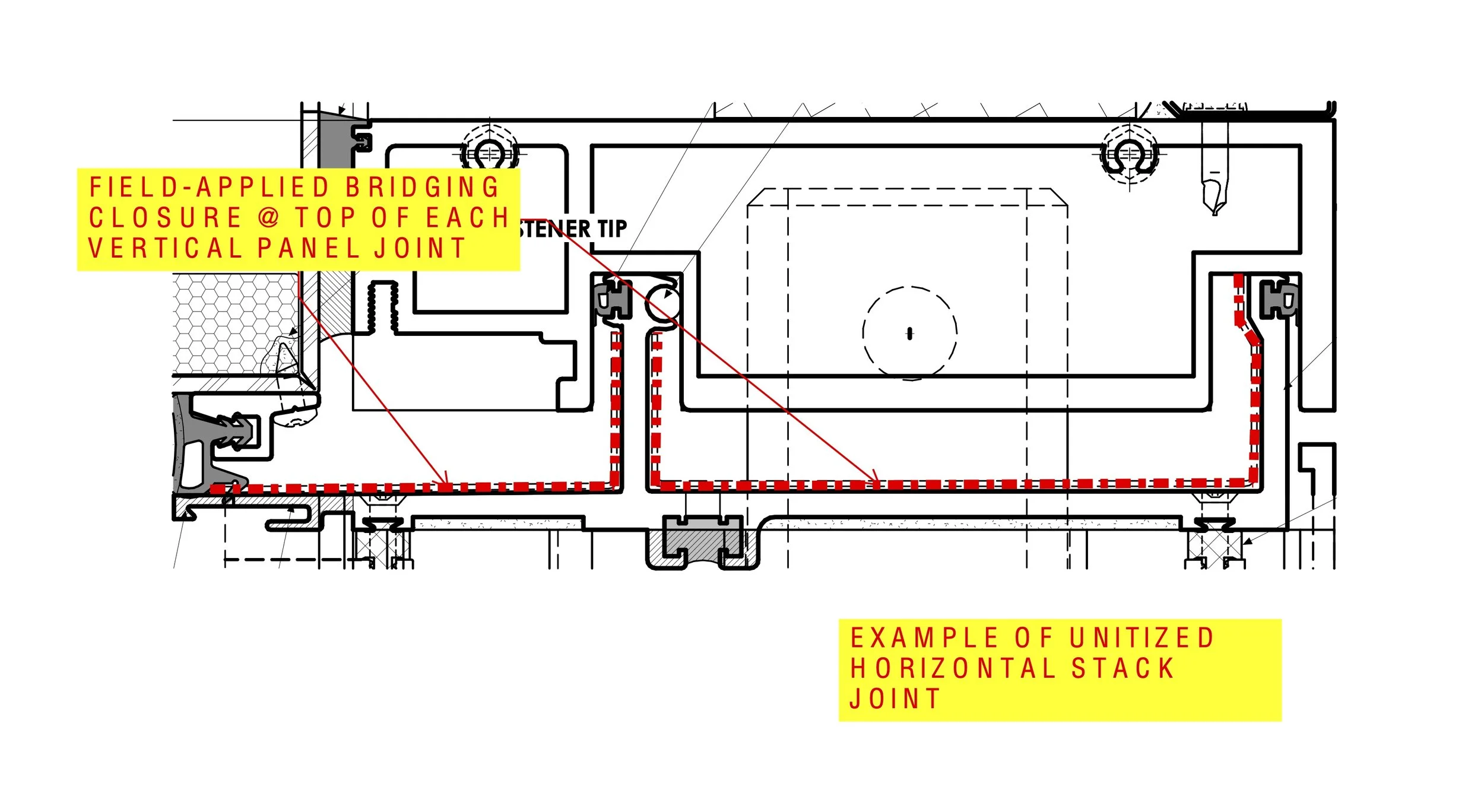
Figure 3 • Unitized Horizontal Stack Joint
It is notable that once the unitized panels are installed, the bridge flashing shown above is concealed from view. It is therefore critical that it is installed properly as there is no ability to make post-installation repairs if a leak is detected at the building interior. If there are hundreds of unitized panels, there are hundreds of bridge flashing locations, each requiring quality control verification.
UNITIZED SYSTEM Strengths
Fast installation of shop fabricated panels resulting in lower installation costs
Favorable cost for uniform curtain wall geometries and large projects
High quality due to shop fabrication
Well suited for regular wall geometries with high levels of repetition
Favorable seismic and inter-story drift behavior
Widely known in the marketplace
UNITIZED SYSTEM Weaknesses
High initial material cost (typically balanced by lower installation costs)
Span limitations (typically 15ft to 20ft); higher spans require secondary steel support behind the glass curtain wall or internal steel reinforcing adding cost
Long lead times after approval of shop drawings
Wide metal sight lines at vertical and horizontal edges of glass panels
Higher costs for complex geometries
Inability to mitigate post installation leaks due to concealed sealant joints*
High transportation costs due to large panels
Requires sequential process during installation (bottom up, right to left)
*When a unitized system experiences water leaks at the interior of the building there is only one fix: face-seal the joints each way. This effectively "converts" the unitized system to a barrier system.
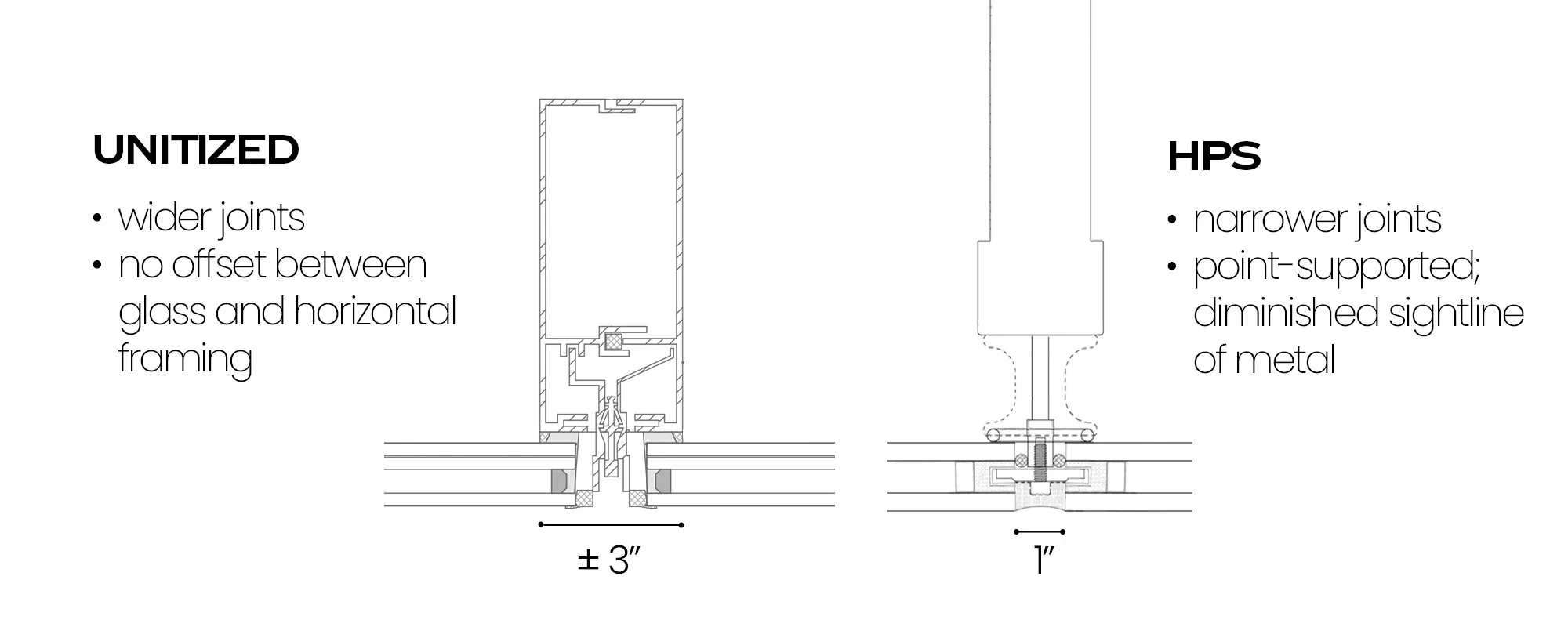
Figure 4 ∙ Joint sight line comparison
Barrier system curtain walls (HPS)
Although there are a number of barrier systems in the marketplace we will focus this discussion on the Hybrid Point Supported (HPS) types. These versions of barrier systems achieve weather integrity regarding air and water through a silicone seal applied to the vertical and horizontal glass joints. They tend to be simple in nature with a minimization of components allowing them to achieve very low material costs.
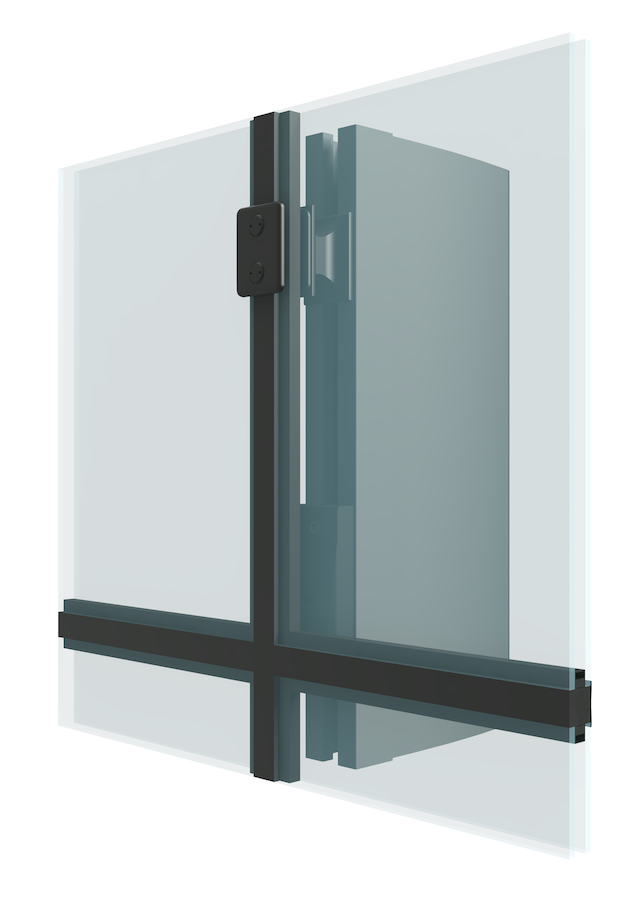
Figure 5 ∙ VS1-A100, a HPS Curtain Wall System
The most prominent examples of a barrier system is the Pilkington Planar system which was introduced to the market in the 1980s. There is a large world-wide body of work over an extended period of time therefore, verifying that barrier systems can provide long lasting facade solutions in various thermal environments.
HPS systems are typically comprised of vertical framing members, tempered glass panels, local fittings that support the glass panels laterally (wind) and vertically (gravity) and structural sealant applied to the glass joints, each way. The use of structural sealant as the weather seal in lieu of standard silicones achieves a higher level of seal integrity even under large joint movements. Once the sealant cures there is no way for water to enter the curtain wall for the duration of the life of the sealant. Dow Corporations structural sealant Dowsil 795 for instance has a observed life of over 50 years. Dow also offers a 10 year VIP material + labor warranty on certain installed barrier systems exceeding any other weather integrity warranty in the marketplace irrespective of systems used. Also due to the sealing strategy, these systems perform exceptionally well regarding air infiltration.
barrier system Key points
Vertical framing, typically extruded aluminum mullions spans slab to slab
Very high spans are possible with HPS systems, currently up to 60ft clear without secondary steel framing behind the curtain wall.
Fittings attached to the face of the framing support the glass either via a small exterior pinch plate or a toggle engaging side channels incorporated into the insulating glass.
A silicone joint filler gasket is pressed into the joints each way from the interior providing backing for the sealant application. Glass joints are typically 1” (25mm) wide achieving very thin site lines of the installed wall.
Structural silicone is applied into the glass butt joints from the exterior to complete the weather seal and achieve a flush aesthetic appearance.
Note: HPS systems can be designed to have the mullions to the exterior which allows the system to be installed entirely from the interior/slab for multi-story applications.
barrier system Strengths
Low material costs
Large spans possible (up to 60ft clear span)
Best in class warranty possible from Dow Corp. (10 year material + labor)
Very transparent facades aesthetic with no horizontal framing
Long weather integrity life (equal to silicone sealant)
Circular system: parts can be disassembled and reused on other projects
Exterior mullions possible creating a flush glass interior
Superior air seal attributes
Reduced production schedule time to site
Can achieve complex wall geometries (fold lines, curves)
Low transportation costs due to condensed packaging
Can be installed in any sequence
Favorable seismic and inter-story drift behavior
Excellent future maintenance attributes
BARRIER SYSTEM Weaknesses
Field sealant application requires high level of quality control
Higher installation costs compared to unitized systems (typically balanced by lower material costs)
Unfamiliar in the marketplace
Figure 6 ∙ Risk Assessment Matrix
HPS: The CURTAIN WALL Solution for Long Spans and Performance
Based on the results above comparison matrix, the barrier system wins the race with more green checkered flags than the unitized approach.
By employing the required quality control in the execution of both unitized and barrier (HPS) cladding strategies, successful building envelopes can be implemented. It is clear that a barrier system has many positive attributes that are generally not understood in the marketplace making it the system of choice for many projects, especially those that require large clear spans. Notably it makes available the most comprehensive performance warranty in the industry to building owners: the 10 year material & labor Dow VIP warranty.

ABOUT THE AUTHOR
FRanz Safford, FACADE ENGINEER
CEO OF INNOVATION GLASS
Franz is an expert in all aspects of curtain wall construction process, from initial conception/design development, engineering, material selection, fabrication, project management and installation. He follows a process that strives for simplicity in the design solution, embracing a philosophy of integrating components to achieve a higher level of efficiency for the end-product. Read Full Bio →
Read More
Explore recent IG Insights to learn more about the VS1 technology and trends in the curtain wall industry.